
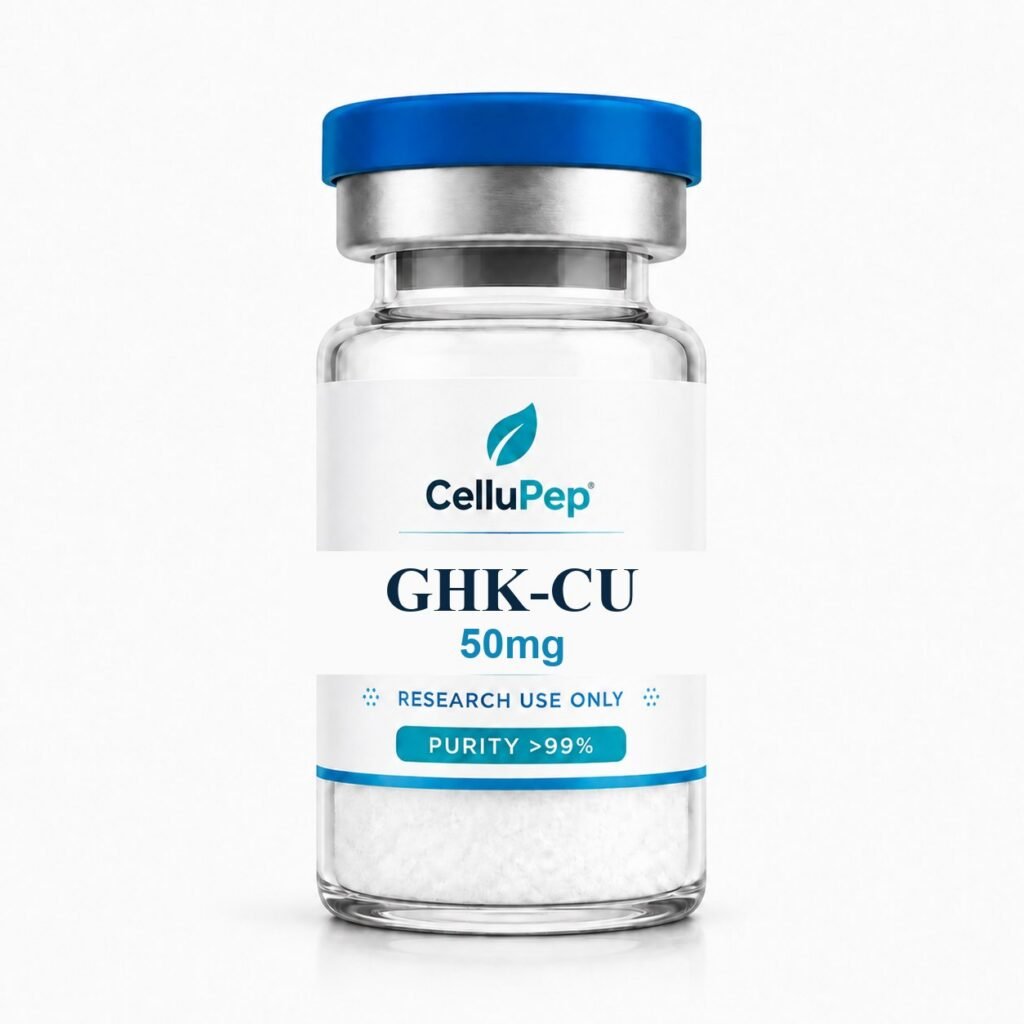
Copper peptide · Research material
GHK-Cu
A copper-binding tripeptide complex for connective-tissue and extracellular-matrix research.
Review the material, compare the listed pack sizes, and prepare the batch-document questions that matter for your laboratory.
Select a catalog specificationSelected: 50 mg per vial × 10 vials
For laboratory research only. Availability and final batch specification are confirmed with the quotation.
01 / Material profile
A small peptide. A distinct copper complex.
GHK is the tripeptide glycyl-L-histidyl-L-lysine. GHK-Cu refers to its copper(II) complex, rather than the copper-free peptide alone.
That distinction matters when comparing chemical identity, supplied form and research references. A study of GHK, a GHK-Cu complex or a formulation containing other ingredients should not automatically be treated as evidence for the same material.
Use the complete material name and the supplied batch documentation—not the short name or vial color—to establish what is being quoted.
Reference context: Maquart et al., 1988. Salt form, composition and analytical specification for the supplied material should be confirmed during quotation.
02 / Published research
What has been studied?
Collagen synthesis in cultured fibroblasts
A cell-culture study investigated GHK-Cu in relation to collagen synthesis by fibroblasts. This provides a specific experimental context—not evidence of a finished cosmetic or of results from this catalog batch.
Maquart et al. · FEBS Letters · 1988 ↗Matrix-remodeling activity
A separate fibroblast-culture study examined matrix metalloproteinase-2 (MMP-2), an enzyme involved in extracellular-matrix turnover. Read the experimental system and endpoints before applying a paper to a different laboratory workflow.
Siméon et al. · Life Sciences · 2000 ↗03 / Catalog options
Know what each pack contains.
| Product | GHK-Cu |
|---|---|
| 50 mg catalog option | 50 mg nominal material per vial × 10 vials |
| 100 mg catalog option | 100 mg nominal material per vial × 10 vials |
| Supplied form / salt | Confirm against the written specification for the quoted material. |
| Purity and identity | Request the method and lot-specific results; the image label is not a batch result. |
| Storage | Follow the supplied label and batch-specific instructions. |
Catalog sizes come from the existing GHK-Cu listing. Mass per vial and number of vials are separate fields; these are not reconstituted concentrations.
04 / Before ordering
Ask for the documents behind the material.
Tell us which information your laboratory needs to review. Document availability and scope must be confirmed for the quoted lot.
Lot-specific COA
Product identity, batch reference and the results reported for that material.
Analytical files
Ask which identity and purity methods and underlying files are available.
Handling information
Storage and stability instructions for the supplied formulation and lot.
05 / Product questions
A clearer specification starts here.
Is GHK-Cu the same as GHK?
No. GHK-Cu denotes a copper complex of the peptide. Confirm that the reference paper and the requested supply use the intended material identity.
Does 50 mg describe the whole box?
The current catalog option is 50 mg per vial, supplied as 10 vials per pack. Include the number of packs separately in your inquiry.
Does the bottle image prove the batch purity?
No. The catalog image is a packaging illustration. Ask for the applicable analytical result and its method for the lot being quoted.
Can I use one storage instruction for every form?
Do not assume the same stability or handling conditions across salts, formulations or lots. Use the documents supplied for the specific material.
- Maquart et al. (1988): GHK-Cu and fibroblast collagen synthesis.
- Siméon et al. (2000): GHK-Cu and MMP-2 in fibroblast cultures.
- Cellu-peptide catalog: listed pack sizes and existing illustration.
Content reviewed for this product page · 26 September 2026. Literature context is not batch certification.
Build your GHK-Cu inquiry.
Choose a pack size, then include the quantity, destination and batch documents you need.