
Multi-component blend / Material & research guide
KLOW
KLOW is a catalog blend label. The component specification must distinguish it from GLOW and from standalone GHK-Cu.
Catalog specification — select for your inquirySelected: 80 mg × 10 vials
Nominal catalog options, not a live availability guarantee. Final supply is confirmed in the written quotation.
Material profile
About the material
KLOW is a catalog blend label. The component specification must distinguish it from GLOW and from standalone GHK-Cu.
For KLOW, the useful starting point is the material identity—not the broad research category. Compare the complete name and supplied form with the reference used by your laboratory.
Confirm GHK-Cu, BPC-157, the material designated TB-500 and KPV individually. Request the amount of each component and clarify full-length versus fragment identity for TB-500.
Scientific context
Research context
Component literature provides background only. It does not validate this combination, its compatibility, stability, biological effect or a supplier batch. No single-material CAS or molecular formula is assigned to the whole blend.
For laboratory research use only. Not for human or veterinary use, diagnosis or therapeutic application. No administration or dosing protocol is provided.
Catalog & quotation
Specifications
| Catalog material | KLOW |
|---|---|
| Material class | Multi-component blend |
| Listed options | 80 mg × 10 vials |
| Identity / supplied form | Confirm GHK-Cu, BPC-157, the material designated TB-500 and KPV individually. Request the amount of each component and clarify full-length versus fragment identity for TB-500. |
| Composition and analysis | Request individual component identity and amount, total fill, and the method used to assess the mixture. A single purity percentage does not establish every component. |
| Storage / stability | Follow the written instructions for the actual material and batch. No universal 24-month shelf life or solution stability is assumed. |
Component-by-component review
| GHK-Cu | 50 mg |
|---|---|
| BPC-157 | 10 mg |
| TB-500 identity to confirm | 10 mg |
| KPV | 10 mg |
Transcribed catalog composition, not an independent mixture assay. Confirm the offered formulation, component identities and content basis in writing.
Evidence for the offered material
Documents
Confirm document availability for the actual material and lot. A catalog purity target or packaging label is not a released batch result.
Confirm GHK-Cu, BPC-157, the material designated TB-500 and KPV individually. Request the amount of each component and clarify full-length versus fragment identity for TB-500.
Ask which tests and underlying files are available, what each result measures and which batch it covers. Do not infer a test result from an image or badge.
Match product name, selected specification, lot reference and packaging to the quotation. Ask about any difference before confirming supply.
Before you inquire
Questions
What does the total blend mass include?
Confirm GHK-Cu, BPC-157, the material designated TB-500 and KPV individually. Request the amount of each component and clarify full-length versus fragment identity for TB-500.
What should my KLOW inquiry include?
Include the exact material name, the catalog option or required specification, quantity, destination and any documents needed before quotation. Keep nominal amount per container separate from the number of containers.
Does the catalog image confirm the selected specification?
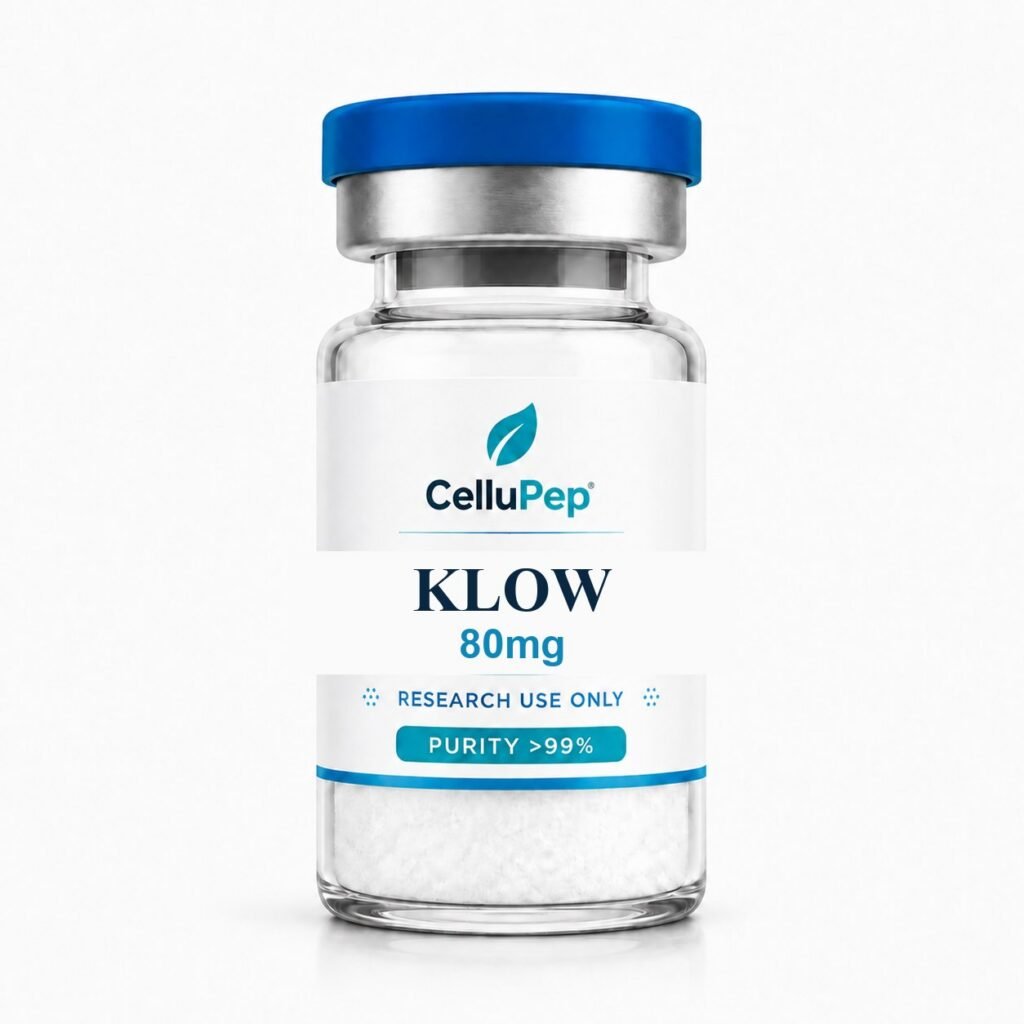
No. It is a catalog illustration. The image may show one variant while the selector lists other options. Use the written quotation and matching batch documents to confirm supply.
Does a paper or an existing report validate every future batch?
No. A paper describes its studied material and model. An analytical report describes a named sample. Confirm the connection between any report and the lot offered for your order.
Catalog content reviewed 26 September 2026. Listed options are from this site's product records. Scientific sources, where shown, describe research context, not batch certification.
Build your KLOW inquiry.
Include the material, amount and evidence your laboratory needs to review.